

Prologue: A Shaft of Light on the Crown
There was a moment, not easily forgotten, when I stood beneath the clinical glare of an operating room light and caught the reflection - not on the glistening edge of a scalpel, but on the perfectly smooth expanse of my father’s scalp as his surgical cap came askew. The future seems to unfold, follicle by follicle, into a landscape of inevitability. I, the product of countless generations of natural selection and sexual competition, stared mortality (and a career in gynecology) in the face and asked: Is this my fate? As for you, dear reader, will you, too, one day draw stares for reasons unrelated to your surgical technique, but rather to the aerodynamic qualities of your exposed cranium?
It’s a question millions of men confront, usually in front of the mirror, sometimes with resignation, occasionally with dread, and, on the rare good day, with a sense of detached scientific curiosity. Today, let’s channel the latter. It beats helpless sobbing over a pint.
My dad was of minimal comfort at the time, leaving aside he was the primary instigator of acute concern. Losing his hair hadn't really bothered him, had it? Or so he claimed. Easy for him to say, he'd managed to skip past the Great Filter and end up married while his flowing locks were still intact. To the relief of men everywhere, once you've put a ring on her and wormed your way into her heart, she's far less likely to fall out with you, if your hair does. Maybe it's because it makes for a more convenient alternative to a compact mirror, but I reject that thesis based on the ubiquity of smartphones and their front facing cameras.
Sadly, I'm (freshly) single and fighting an uphill battle as an Indian in the West. I need every advantage man or medicine can provide me.
I set out, as any responsible pseudo-rationalist blogger would, to audit my own risk. I armed myself with pubmed abstracts, twin studies, family history, and the sort of speculative Bayesian reasoning that makes medical geneticists and actual Bayesian statisticians cringe in tandem. This lead to a forecast of a happy ending for me, and maybe for you too. If not, forewarned is forearmed, and you can start factoring the savings on shampoo early.
Part I: The Topography of the Norwood Jungle
Before you can escape a jungle, you have to know its terrain. The Norwood-Hamilton scale is the cartographer’s map for male pattern baldness (androgenetic alopecia, or AGA), dividing male scalps into a taxonomy of misery, from Norwood I (thick, untamed rainforest) to Norwood VII (Madagascar, post-deforestation). It’s less a continuum and more a sequence of discrete way stations, each representing a quantum of hair loss, each with its own distinctive ecosystem of coping strategies.
Key Statistics:
By age 50, approximately 50% of men show some degree of AGA.
By age 70, the figure rises to 80%.
Early onset (before 30) is predictive of more severe lifelong hair loss.
Population data is comforting only in its universality. If you’re male, the odds are even, pretty much a flip of the a fair coin, that you’ll lose some hair by 50. However, this is not a Markov process (look mom, I know some big words!). The probability that you’ll progress to the next Norwood stage is not independent of family history or your age at onset (if any). This is where things get annoyingly Bayesian.
Part II: The Heritability Swamp
Androgenetic alopecia is as heritable as height or intelligence. Estimates hover around 0.8, meaning 80% of the variance in AGA is down to genetics. But this isn’t Mendel’s garden, which is a lie-for-children. There’s no simple dominant/recessive model, no single gene you can blame when you’re standing in the shower collecting stray hairs and existential despair.
The X-Factor:
The AR (androgen receptor) gene on the X chromosome is the headline act. Because men inherit their X from their mother, the old adage “look at your maternal grandfather” has some merit. However, this is a gross oversimplification. Autosomal genes contribute, and the variance explained by AR alone is underwhelming.
Crucially, the AR gene resides on the X chromosome. Since men (XY) receive their X chromosome exclusively from their mothers (XX), the specific variant of the AR gene you possess is inherited maternally. My own maternal grandfather, with a respectable head of hair well into his nineties, was the first major piece of evidence that my case was not so clear cut.
But if the AR gene were the whole story, a bald father would be genetically irrelevant. Yet we know this isn't true. Male pattern baldness is not a simple Mendelian trait. It is a polygenic conspiracy.
Part III: The Other Kind of Poly
In common with the other rationalist hobby, polyamory, it's often multiple things/people screwing you over. To a degree, your hair's fate is decided by committee.
While the AR gene is the strongman of the operation, it's far from reigning alone. Modern genome-wide association studies have revealed a veritable committee of genes that hold sway over your scalp. This polygenic nature means you inherit a portfolio of risk from both parents. Your father cannot pass you his X chromosome, but he gives you half of your 22 other pairs of chromosomes, littered with these lurking baldness genes. This explains the messy reality of family hair patterns and why my own paternal uncles have mixed fates. You won't find a single switch, it's a complex scorecard of genetic predispositions.
Empirical reality:
If your dad is bald: Your risk is higher than population baseline, but not deterministically so. I've seen figures of anywhere from 2.5 to 6 times the relative risk.
If your maternal grandfather is bald: Marginally more predictive, but still only part of the story.
If you have thinning in your 20s: Much higher odds of severe baldness later.
Genome-wide association studies (GWAS) have identified hundreds of loci involved, each imparting a tiny, cumulative nudge towards follicular failure. There are risk scores, but their predictive value is mediocre unless you’re at the extreme tail of the polygenic distribution.
Part IV: The Phenomenology of Balding
No one ever sits you down as a child and explains what it feels like to lose your hair. It’s not dramatic; there’s no moment of cinematic self-discovery. Rather, it’s an incremental process, almost geological in its patience. Those strands are hair today, gone tomorrow, or so it might seem even if it's all gradual. Unless you're a chemo patient or in the ICU, it's not coming off in clumps.
The average scalp contains about 100,000 hairs. Each is in a cycle: anagen (growth), catagen (regression), telogen (rest). In AGA, affected follicles miniaturize under the influence of dihydrotestosterone (DHT), shrinking the anagen phase and producing progressively wispier hairs until they disappear, leaving only the stubborn, genetically resistant horseshoe.
Observable Stages:
Diffuse thinning: Most men notice it too late, after 30% or more of their density is gone.
Recession: The hairline starts to resemble a geographical retreat from an advancing enemy.
Vertex loss: A slow, inexorable clearing at the crown.
The social and psychological implications are vast - entire industries thrive on the anxiety this process produces. There is no shortage of snake oil; there is only a shortage of effective intervention. (The OG snake oil, among many other claims, was peddled as a solution to hair fall too)
(While I can't truthfully claim to have seen a patient come to the psych clinic with complaints of baldness quite yet, I'm just a baby shrink, and I certainly wouldn't be happy should my hair begin to go.)
Part V: Intervention - Snake Oil, Science, and Sunk Cost
The battle for the scalp is as old as civilization, and almost as fruitless. Ancient remedies ran from hippopotamus fat to arsenic. Modernity gives us minoxidil (topical, rarely oral), finasteride (oral), and if you are so inclined, surgical reforestation via FUE/FUT (for a modest sum and a weekend in Istanbul).
The Evidence:
Minoxidil: Increases blood flow, extends anagen phase. Works moderately, must be used indefinitely, otherwise all progress is lost. I can attest to some effectiveness. No, I'm not lying about not being balding, I, along with my little brother, had annoyingly patchy beards into our early 20s. He stuck to a regime and has a beard, which, if not quite Dwarkesh Patel standards, is eminently respectable. Mine turned out okay enough by itself, so I stopped bothering. If I were to contact him while writing this essay, he'd likely yell at me to endorse micro-needling to improve absorption.
Finasteride: 5-alpha-reductase inhibitor, lowers DHT, slows or halts miniaturization in most men, some regrow. Side effects rare but widely publicized.*
Dutasteride: More potent cousin, greater risk, only off-label for AGA.
Hair transplantation: Effective for many, but can be expensive, and donor supply is finite.
Toupees: Not the most graceful of options, but they're there.
Acceptance: You can always resign yourself to your fate. I'm iffy on how effective this is in practice.
*Back when I was studying for Indian postgraduate residency exams, I ran across a rather entertaining lecture in a boring sea of pharmacology. Our professor told us that, being a doctor of a certain age, with friends the same, he'd been approached by many of them seeking a solution to their hair loss.
His first recommendation was minoxidil. His buddies were eager to know more, but were turned off by the fact that it took months of quasi-religious application to show effect. Is there a faster alternative, they demanded?
Well, there's finasteride, he told them. Works like a charm, and much faster. This was enough to get them excited, but they tended to deflate like a balloon when he told them that while they might regain their hair, they would lose their girlfriends/fiancees in the process. Minoxidil would do, they declared in defeat.
(This is somewhat of an exaggeration on his part, but it made for a good story)
The Career Path of the Balding Man
If baldness is destiny, some see it as a path to gravitas. Witness Scott Alexander, whose follicular demise coincided, suspiciously, with his rise to blogging superstardom and whose readers appear to trust him more for his aerodynamic silhouette. In some cultures, baldness is a symbol of wisdom; in others, an excuse for creative headwear.
I am convinced that, in medicine at least, patients gain immense confidence in their doctors when they're either greying or balding. Glasses help too. While this is a misguided belief, with 30ish doctors having the best patient outcomes, who can really talk them out of it? I've read and enjoyed Scott's posts about his visits to the AAP conferences before, and he quite rightly observes that most psychiatrists devolve into either the stern-and-balding or matronly stereotype.
For those who truly cannot bear it, Turkey awaits, ready to turn your savings into 2,000 grafts and a lifetime supply of minoxidil. It’s capitalism at its most intimate.
Part VI: The Statistical Gripe - Bayes in the Bald Patch
Here’s what annoys me as both a consumer of medical statistics and a person at personal risk. There is an abundance of data on the probability that your relatives are bald if you are - around 80% of men with AGA have a bald father. But the inverse probability, i.e., “what is the chance that I will go bald, given my father is bald,” is much less well characterized, partly because of ascertainment bias and the basic non-Mendelian nature of the inheritance. I don't get to apply Bayes’ theorem all that often in my actual day job, so here's a crack at it.
If you want numbers:
Let’s formalize it:
Let
A = “You are bald by age 50”
B = “Your father is bald by age 50”
P(B|A) = 0.8 (about 80% of bald men have bald fathers)
But P(A|B) is what we want.
Using Bayes’ theorem:
P(A|B) = [P(B|A) * P(A)] / P(B)
If prevalence of male pattern baldness by 50 is 0.5 (P(A)), and prevalence of baldness in fathers is about 0.5 (P(B)), you end up with P(A|B) = 0.8 * 0.5 / 0.5 = 0.8
But this only holds if all the numbers are accurate and independent, which they are not. In practice, the risk is elevated, but not deterministically so. The point is, even with a bald father, you are not consigned to follicular oblivion.
Complicating the calculation further is the polygenic nature. If you have a bald father and a maternal grandfather with a full head of hair, you are in the ambiguous middle. If you reach your late 20s with no thinning, your odds plummet regardless of family history.
I suppose, having actually looked up some numbers, it's worth working through a specific example, which would be moi, dear reader.
Part VII: Escape from Norwood - A Personal Update
Family History: The Cue-ball doesn't fall far from the coconut
In my case:
Dad: Happily bald, too old and successful to give a fuck. Has a taste for absolutely terrible hats to keep the chill at bay.
Maternal grandfather: Hair finally started greying somewhere around 80, yet holding onto most of it well past the age of 95.
Paternal uncles: Only 1 in 3 bald, all older than my father.
Me: Late 20s, no recession, no thinning, yet unhappy settling my internal debate on that basis alone.
Turning those into things we can usefully multiply:
Baseline risk by age 50: ~50%
Adjusted risk with bald father: up to 60-70%, but the variance is huge
Maternal grandfather with full hair: Lowers risk by ~10-20%
No thinning by age 30: substantially below average risk of severe MPB
The result? A Bayesian would say my posterior risk, updating from population priors, through the lens of family phenotype, and my own apparent resilience, is lower than baseline, and rapidly declining as I approach 30. Age itself is a strong negative predictor: if you’ve, like me, have almost made it to 30 without significant loss, you're increasingly unlikely to undergo rapid, catastrophic Norwoodification.
Addendum: The Perks of Being Indian
But very late into this essay, written as it is in an effort to keep me awake after multiple route disruptions on British trains, I remembered to check a crucial variable I had overlooked: what difference does being Indian make?
The answer? A lot.
Caucasians have the highest prevalence and the earliest average onset of AGA in the world. The statistic that "50% of men have some hair loss by 50" is heavily weighted by data from Caucasian populations.
In contrast, Indian (South Asian) men, along with many other Asian populations, generally have a lower prevalence of moderate-to-severe baldness and a later average age of onset compared to their Caucasian counterparts.
We've also got very relevant differences in the quality and texture of the hair itself, as well as the pattern of baldness:
On average, Indian hair has a thicker diameter than Caucasian hair while even the scalp hair density (follicles per square centimeter) is also typically higher in Indian men. We also don't adhere very closely to the classic Norwood pattern, which was designed for Caucasian audiences. Our hair tends to go from the very top, which is somewhat easier to hide than y’alls tendency to develop a five-head early in the process.
It's no surprise I didn't think of this, since my anecdotal evidence is that there's no shortage of ungracefully balding Indian uncles both at home and abroad. But the numbers don't lie here.
So, as I write this, hair intact, approaching 30 with a sense of cautious optimism, I can tentatively declare: the jungles of Norwood are not as inescapable as they appear in adolescence. The receding tide of DHT has, for the moment, spared me. If I begin to thin in my 40s or 50s, I’ll chalk it up to the unstoppable advance of entropy, not genetic injustice. Besides, assuming AGI doesn't kill me, I sincerely hope to be shacked up and enjoying some degree of professional success.
If the worst occurs, I’ll have options. Minoxidil, finasteride, or a weekend among the domes and kebabs of Istanbul. Or, failing that, I’ll take solace in the careers of Julius Caesar, Patrick Stewart, and the aforementioned Scott Alexander.
Maybe going bald is the secret handshake for joining the global brotherhood of men who no longer care what people think - except about their ideas. Maybe that’s the tradeoff.
(There's a fine line between healthy coping skills and outright copium, my textbooks are silent on where that border is)
Epilogue: The End of Hair and the Beginning of Wisdom
Baldness is the ultimate memento mori, a daily reminder that no matter how much we delude ourselves about agency and control, genetics always gets the last laugh. But in the jungles of Norwood, a little rationality and some well-applied Bayesian reasoning can at least arm you with a map, a compass, and a sense of humor. (If you're even more sensible, the compass points towards the nearest airport serviced by Turkish Airlines.)
If you escape unscathed, thank your maternal grandfather. If not, there’s always a cheap and cheerful cosmetic surgeon somewhere nearby.
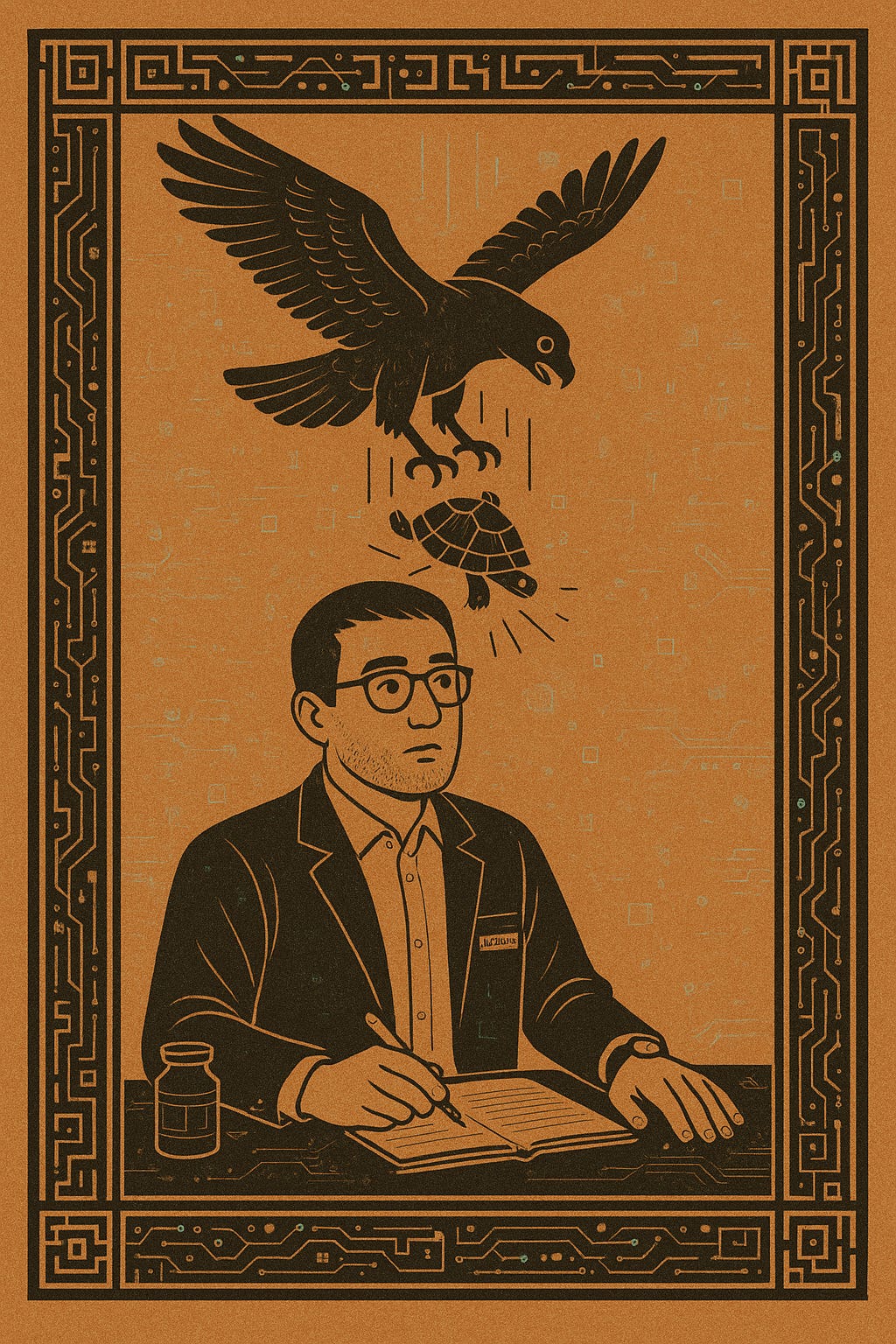
And remember: the real enemy is not baldness. The real enemy is the tortoise, which has prematurel ended the life of many a smooth-pated man since Ancient Greece. Or perhaps it's letting your self-esteem be defined by strands of protein. Escaping the jungles of Norwood, in the end, is about finding your way out of the mirror and back into your own life.
References:
Norwood OT. Male pattern baldness: Classification and incidence. South Med J. 1975.
Ellis JA, Sinclair R, Harrap SB. Androgenetic alopecia: pathogenesis and potential for therapy. Clin Dermatol. 2001.
Heilmann-Heimbach S, et al. Hunting the genes in male-pattern alopecia: how important are they, how close are we and what will they tell us? I forgot which journal, but you can find it on pubmed.
Pirastu N, et al. GWAS for male-pattern baldness identifies 71 susceptibility loci explaining 38% of the risk. Nat Commun. 2017.
(The internet on the train is too spotty for me to be arsed to figure out where I left the rest of my citations.)
I want to address a few things:
1) 50% balding by 50 seems to be an underestimate. The amount of Norwood 1/0 with no diffuse thinning at the age of 50 seems to be well under 50%. I'm 25 and I'd say already like 20-30% of guys I meet my age have at the early stages of androgenic alopecia.
2) Dutasteride is more potent but it has the same or even less prevalent side effects than finasteride. The only downside would be if you do get them, the longer half-life would make them last longer.
3) In my ancedotal experience, Indian men are some of the worst balders, on par with Southern Europeans white guys. I found an a survey result saying 50% had noticed hair loss by 25.
Bald person here, maybe it’s just a case of making lemonade out of lemons, but I welcomed losing my hair, getting it styled and cut was a hassle to me. Nowadays keeping it tidy is a once a week shave in the shower. Perhaps it would have hampered my marital prospects (like your father I went bald after marriage) but I doubt it. My brother went bald at an earlier stage than me and he definitely didn’t suffer in that department (to his cost unfortunately).
I do wonder at the evolutionary reasons for male pattern baldness though. My personal guess is that it has something to do with the same reason women survive long after menopause, which seems to be about caring for grand children (based on the famous Quebec study). Baldness is perhaps giving the signal to young women of a mature man who should be investing in their grandchildren rather than siring new children. This is somewhat contrary to my claim above, but I justify it by saying that it could be that women of a similar mature age wouldn’t perhaps be as dissuaded.